

 Facebook
 X
 Pinterest
 Copy Link
What to Watch Out for When Buying a Home

Saving up for a down payment and closing costs. Getting your credit into tip-top shape. Lowering your debt-to-income ratio. These are the basics of buying a home. But before you settle on “the one”, watch out for these possible red flags.
What to Watch Out for When Buying a Home
Odors
Sellers use fragrance to entice buyers. They also may use fragrances to mask larger issues. Use your nose to root out musty smells. This may indicate a potential water leak or even mildew/mold. Likewise, pet smells could mean possible damage to flooring that may extend beyond the carpet pad or underlining. Also, beware of overly fragrant properties. You won’t know for sure if the seller is trying to hide a problem or not until you get an independent home inspection done.
Messy/Dirty
Again, most sellers want to put their best face forward when selling their property. So, if they cannot even manage to clean up the house before they sell it, what else are they not taking care of? Make sure you look carefully beyond the mess.
Too Good to Be True
On the other hand, beware of a home that looks “too perfect”. Sure, the furniture is placed beautifully. And the accessories are stunning. Instead, look beyond the flashy topcoat and investigate the “bones” of the property. That’s where the value lies. Again, this is where a good home inspection comes in handy.
Surroundings
How’s the neighborhood? Well-kept lawns and tidy appearances tend to indicate pride of ownership. Cars on the lawn and poor curb appeal bring down your property’s value. Do your homework before you buy. Safewise offers seven tools to help you find out just how safe your neighborhood is.
Commute Time
Finally, with more and more people going back to work at a physical office again, commute time becomes another concern when buying a home. Pay attention to the amount of time it takes you to get from home to work and back again. Believe it or not, the daily grind becomes a drag pretty quickly, especially if it involves an hour or more drive time each way per day. Is the home really worth the hassle of dealing with traffic?
Muna Dionne, your Inland Empire specialist with Coldwell Banker Realty
The Importance of Your Credit Score
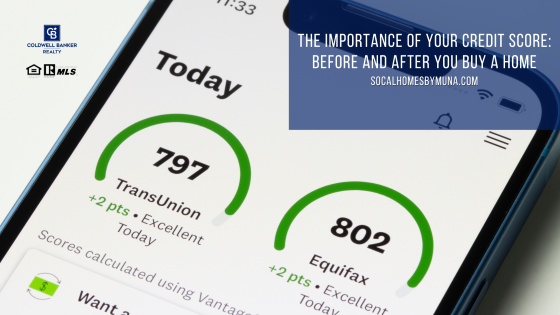
Lenders look at several things when determining whether or not to approve you for a home loan. Income. Debt. Debt-to-income ratio. Down payment. And, of course, your credit score. Did you know, though, that you should not let your credit slip once you sign those closing documents?
The Importance of Your Credit Score
Before You Buy a Home
A good credit score shows lenders that you handle debt responsibly. With a higher score comes better interest rates, too. With rates well above the 7% mark, you want to save wherever possible. While some programs allow for a 580 FICO score, that also means paying a much higher interest rate. Besides, conventional loans require a minimum of 620, with other loans requiring at least a 640 score for approval.
After You Buy a Home
I know what you’re thinking. “But Muna. Once I am an official homeowner, why can’t I be less vigilant about my credit score?” Well, several reasons. First of all, employers sometimes look at your credit score when considering you for a job. They equate good credit with responsibility. Second, saving money on your credit cards. Credit card companies offer better rates for those with better scores. Third, new home, new furniture, right? Well, that may mean borrowing money to pay for it. Again, a better FICO score means a better interest rate. And that translates into saving money.
Next, what about when interest rates start to fall? It may not seem possible now, but there is a good chance that interest rates will come down again in the future. At that time, you may want to refinance at a lower rate in order to save some money on your mortgage. If you let your score take a hit, that may not be possible. Finally, what about when you decide to sell your current home and look for something else? You’re going to need that great score to get the best rates then, too. It’s much harder to bring your score up to a great level if you let it tank first.
Muna Dionne, your Inland Empire specialist with Coldwell Banker Realty
How Can I Lower My Mortgage Rate?
You decided to buy a Southern California home. You saved up enough money for your down payment and closing costs. After you asked the right questions, you find a lender you trust. Now, it’s time to talk money. As of the writing of this post, interest rates for a 30-year fixed-rate loan sit at around 7.18%. Now, that may cause concern for some home buyers. But there are a few ways in which you could possibly lower your mortgage rate and make homeownership a little more affordable.
How to Lower Your Mortgage Rate
Go Adjustable
First, instead of the fixed-rate mortgage that many home buyers chose when rates were lower, try an adjustable-rate mortgage. The rate starts off lower and stays that way for a set period of time (anywhere from the first three to the first ten years of the loan). However, after that set period, the rate then goes up. If you plan on staying in your home for only a few years before selling it, this might actually make more sense than a fixed-rate loan.
Shorten Your Term
Another way to lower your rate is by going with a shorter term. Right now, Freddie Mac shows interest rates for a 15-year fixed-rate mortgage are 6.51%. That’s 0.67% lower. However, with a short term comes higher payments. On the positive side, though, that also means building equity faster and paying off your loan in a much shorter amount of time. So, if you can afford to make higher payments each month, it could be well worth it.
Paying Points
Yet another way to lower your rate is by paying for discount points. Each point costs about 1% of your loan value. For example, if you borrow $400,000, a point costs $4,000. For that point, your interest rate decreases by 0.25%. However, the pricing varies from lender to lender. Also, you need to determine whether the time it takes to recoup your costs of paying for points is worth the expense. Your lender can help you with these calculations.
Increase Your Down Payment
Some mortgage programs only require 3.5% down. But if you pay even 5% of 10%, you look like a better credit risk to lenders. In turn, your rate goes down. If you can come up with 20% down, you get the best rates possible and you no longer pay PMI, which can save you a few hundred a month.
Shop Around
Finally, shop around. Rates, terms, and fees vary from lender to lender. So, it never hurts to check out a few different lenders before deciding on which one works best for you.
Muna Dionne, your Inland Empire specialist with Coldwell Banker Realty
Fannie Mae Explained

When buying a Southern California home, most people talk about interest rates, how much to save for a down payment, and loan pre-approval. But what happens with your home loan after you purchase your property? Some companies purchase loans from mortgage lenders on what is known as the secondary market. Two of these companies are Fannie Mae and Freddie Mac. This week, I’ll be discussing how the former operates.
Fannie Mae Explained
A Little Background
During the Great Depression, everyone struggled. Homeowners. Non-homeowners. Businesses. Banks. As part of FDR’s New Deal, Congress founded the Federal National Mortgage Association (aka “Fannie Mae”) in 1938. Instead of providing direct funding to borrowers, this organization bought existing mortgage loans from lenders. In turn, this freed up money for banks to offer up mortgage loans to more borrowers. Currently, Freddie Mac and Fannie Mae represent the two largest operators in the secondary mortgage market.
What Does Fannie Mae Do?
Fannie Mae takes these loans that it buys from lenders and turns some of them into mortgage-backed securities. These MBS are then sold to investors. Additionally, they provide counseling and financial programs that help low to moderate-income buyers purchase their homes. Their Home Ready program (geared primarily towards first-time home buyers) backs loans with as little as 3% down. Their 97% LTV program (aka “Conventional 97”) also backs loans with 3% down for home buyers with a slightly higher income level than those in the Home Ready program. If you currently own a home with considerable equity, their ReFi Now program helps you use that equity to lower your monthly housing costs even with a debt-to-income ratio as high as 65%. Finally, their HFA Preferred program operates similarly to an FHA. However, they request as little as 3% down, charge a lower mortgage insurance cost per month, and allow buyers to cancel their mortgage insurance once certain requirements are met among other things.
Talk to your lender about what Fannie Mae can do for you.
Muna Dionne, your Inland Empire specialist with Coldwell Banker Realty
Guide to Buying a Home to Age in Place

The following is provided courtesy of the wonderful people at Caring.com.
If asked about major life changes, most people would probably think of their younger days. While some older citizens are settled since their decades of work and raising children are far behind them, others make significant lifestyle decisions in their golden years, including where they will live if their current home is no longer suitable.
The home they purchased many years earlier might have cumbersome stairs that they struggle to climb, a yard that’s difficult to maintain, or more rooms than necessary. Its location may not be suitable either because it’s too noisy and busy or too far from anywhere.
During this time, some seniors seriously consider aging in place. This term refers to older people who choose to live independently in their own homes as they age, rather than entering a residential care community, such as assisted living. A University of Michigan National Poll on Healthy Aging conducted in 2022 asked a sample of seniors nationwide about their preferences regarding aging in place. This study found that 88% of 50-80-year-olds think it’s important to remain in their homes for as long as they safely can.
This guide considers several aspects of aging in place, including the best location to age in place, what seniors should look for in a new home, and which professionals can make relocating easier. It also covers several options for buying a home and finding ways to pay for it.
Where should you age in place? What should you consider about the environment surrounding where you choose to live? What should you look for in the home you choose? How should your personal preferences factor into your choice? Who can help you find the right home to age in place? How are you going to pay for that home? Find the answers to these questions and more by reading Caring.com’s “A Guide to Buying a Home to Age-in-Place“.
Muna Dionne, your Inland Empire specialist with Coldwell Banker Realty
Common Contingencies Home Buyers Ask For

I previously talked about what to negotiate when buying a home. These included things like furniture, a home warranty, repairs, and timing. It is not unheard of for buyers to make requests for certain circumstances to be met in order to complete a sale. These are called “contingencies”. Here are a few common contingencies that home buyers ask for as part of the sale.
Common Contingencies Home Buyers Ask For
What is a Contingency
First, it may be helpful to explain what a contingency actually is. In a real estate transaction, a contingency is a clause put into a sales agreement that requires a specific action. If these conditions are not met, the sale may fall through. For the buyer, this may also mean receiving their earnest money back. But only if the specific contingency is actually listed in the agreement and okayed by both parties.
Home Sale Contingency
First up? The home sale contingency. For many buyers to qualify for a mortgage on a new Inland Empire home, they must first sell their current home. Otherwise, they may end up dealing with two mortgages…at least for a bit. But in order to do that, they must qualify for two mortgages. A home sale contingency states that the buyer has a certain amount of time to sell their current home. If they don’t, then the seller puts the property back on the market.
Appraisal Contingency
An appraisal contingency provides a safeguard for the buyer in case the appraisal comes in below the agreed sale price. Why is this important? Because lenders will not approve a mortgage loan for more than the home’s appraised value. If that happens, the buyer has three options: come up with more money down, try to negotiate a lower sale price, or walk away.
Home Inspection Contingency
Next…the home inspection contingency. First, California buyers are not required by law to conduct an official inspection of the property before purchasing a property. However, it makes good sense to do so. The home inspection contingency allows a buyer to back out of a sale if it shows any major issues. But keep in mind that minor issues may show up even on newly constructed homes. And instead of walking away, you might want to negotiate either the completion of repairs or reducing the price of the property to compensate for the cost of repairs/replacement instead.
Financing Contingency
Finally, the financing contingency. This states a specific time period that the buyer must obtain financing for the home’s purchase. In today’s market, many sellers won’t even entertain an offer without a pre-approval letter from a reputable lender. So make sure you get your ducks in a row financially speaking before you start looking at homes.
All of these common contingencies help a buyer keep their earnest money deposit in case a sale falls through. Talk to your Southern California REALTOR® about which (if any) of these contingencies you need to put in place when buying a home. It’s always better to be safe than sorry.
Muna Dionne, your Inland Empire specialist with Coldwell Banker Realty
Debt-to-Income Ratio and the Home Buying Process
I’ve talked about pre-approval vs pre-underwriting. I also explained loan-to-value. But another term any home buyer who finances their mortgage needs to understand is debt-to-income. Why? Because it may mean the difference between loan approval and heartbreak.
Debt-to-Income Ratio
What is It?
In a nutshell, the debt-to-income ratio (DTI) is how much of your income is used to pay your debts. These debts include credit card payments, car loan/lease payments. student loan payments, child support, and mortgage or rent payments among other things. To determine your DTI, take the total of all of these payments and divide it by your monthly income before taxes. For example, let’s say that your payments total $2500. Your annual household income is $84,000. That works out to $7000 a month before taxes. A lower debt load looks much more attractive to lenders than a higher debt load. And if your DTI ratio goes above a certain percentage, lenders may decide that you are not a good credit risk.
What is a Good DTI?
The number varies from lender to lender. However, typically, lenders like to see a DTI of around 36%. However, some lenders go as high as 43%. Of that debt, no more than 28% should go toward your mortgage. In the example I gave above, $2500 falls just under 36% of your income. If your DTI gets too high, you run the risk of not being able to meet all of your financial obligations. Therefore, you run a higher possibility of defaulting on your loan.
What to Do Before You Apply for a Mortgage
Tackle your debt load. Pay down balances on all of your revolving credit accounts. Get your credit card balances under 30% of their limits. Why? Lenders also look at credit utilization. Maxed out on your credit cards? Lenders see this as fiscal irresponsibility or that your finances are stretched as far as they can possibly go. Neither one of these looks great to banks. Start lowering your debt-to-income ratio as soon as possible to present yourself in the best possible light when it comes time to apply for a mortgage loan.
Muna Dionne, your Inland Empire specialist with Coldwell Banker Realty
Earnest Money and Its Role in the Home Buying Process
So, you decided to buy a Southern California home this year. You scrimped and saved in order to come up with a good down payment. After looking at several homes, you found one that you absolutely love and plan on making an offer. Once the seller accepts your offer, you enter escrow. What’s next after that? Your earnest money deposit. What is that and how does it factor into the home-buying process?
Earnest Money and the Home Buyer
What is It?
In a real estate transaction, a buyer will be asked to put down an earnest money deposit when entering escrow. Also known as a “good faith deposit”, this shows the seller just how serious you are about buying the home in question. This good faith deposit exists independently from your down payment. If you back out of the deal due to reasons outside of any contingencies in place, the seller keeps this money.
How Much is Enough?
But how much money should you expect to put down as an earnest money deposit? According to the Credit Union of Southern California, 1% to 3% of the sale price of the home is typical. For a $450,000 home, that means anywhere from $4500 to $13,500. This money gets deposited into an escrow account held by a third party for safekeeping throughout the escrow process.
What Happens to This Money After Closing?
Upon a successful close, the earnest money deposit usually ends up as part of the buyer’s down payment. If the buyer decides not to purchase the property, they may get their earnest money back as long as they have a contingency in place that covers the reason why they backed out. Some typical contingencies include a home sale contingency, a home inspection contingency, an appraisal contingency, and a financing contingency. But if a contingency is not in place, that money automatically defaults to the seller.
Before you decide on how much money you want to provide in good faith with your offer, make sure you really want the home. Sometimes, you may offer even less than 1% to show interest to a seller. Talk to your real estate agent before determining how much money is enough and to make sure you include contingencies that protect you and your money in case the sale falls through.
Muna Dionne, your Inland Empire specialist with Coldwell Banker Realty
Important Questions to Ask Before You Buy a Home

You saved up money for your down payment and closing costs. Then, you found an agent you love and trust. After searching and searching, you finally found the Southern California home of your dreams. But before you put in an offer to buy a home, you might want to ask your real estate agent a few important questions first.
Important Questions to Ask Before You Buy a Home
Is This a Home YOU Would Buy?
Sometimes, you just need to ask a blunt question like this to get an honest response. If your REALTOR® sings its praises, then yay! But, if they respond with concerns, it might do you well to heed their warnings. The decision ultimately lies on your shoulders. However, input from a professional can make this decision easier.
What Contingencies Should I Ask For?
Typically when you buy a home, it is normal to ask for some contingencies. These clauses set conditions on an offer in order to complete a sale. When you include contingencies and they are not met, you (the buyer) can legally walk away with your earnest money in hand. For example, you may need to sell your current property before you can buy a new one (home sale contingency). Or you want to make sure the house appraises for the sale price (appraisal contingency). Lenders will not approve a loan for more than a property is worth at the time of the sale.
Another smart contingency to ask for is a home inspection contingency. Your inspector may end up finding issues that you did not see on your initial walkthrough. In turn, you might go back and negotiate for the repairs (or their costs). Or, if you feel the issues are insurmountable for you, you may choose to walk away from the deal. Finally, a mortgage contingency means that if the bank does not approve your loan, you are not responsible for buying the new home in question. As you can imagine, sellers are not too keen on this possibility. Reduce the chances of this happening by obtaining pre-approval or pre-underwriting status before you start looking for a new Southern California home.
When is the Next HOA/Condo Assessment Due?
California has almost 50,000 HOAs in the entire state. Almost one-quarter of all California homeowners live in an HOA community. That includes condos. So, you run a good chance of buying a home that is part of an HOA. Every so often, the HOA runs an assessment to determine if they need to collect additional fees from homeowners for things like community improvements, repairs, etc. These are one-time payments required by homeowners that go above and beyond their regular monthly fees. It helps to know when the last assessment was done. If it has been a while, you may be in for another one soon.
Do You Have Any Recommendations for…?
Finally, unless you personally know someone in the area, your REALTOR® may be able to recommend a home inspector, a handyman for both the little things and the big things, a landscaper, a real estate attorney, etc. It never hurts to ask.
Muna Dionne, your Inland Empire specialist with Coldwell Banker Realty
How an Escalation Clause May Win Over a Home Seller

Since 2020, the real estate market went crazy. We saw prices and demand spike to levels not seen in a very long time. Homes sold well over asking in less than a day on the market. Higher interest rates, inflation, and rising prices have tempered that feeding frenzy a bit. However, while those crazy times may have passed, sellers sometimes still receive multiple offers for their homes…especially in highly desirable neighborhoods. In that case, a buyer’s secret weapon may be an escalation clause. What’s that and when/how should you include it in your offer?
How an Escalation Clause May Win Over a Home Seller
What is an Escalation Clause?
As a potential home buyer, you offer a specific amount for a home. An escalation clause (aka “escalator”) says that you also offer to increase your price in certain increments up to a set limit. For example, let’s say the list price is $400,000. You offer $400,000 but then include an escalator of $5000 over the highest offered price up to $425,000. So, if the seller receives another offer at $415,000, your offer bumps up to $420,000.
When Should a Home Buyer Include It?
If you find yourself in a bidding war with other buyers, you might want to include an escalation clause as part of your offer. This especially rings true if you really believe this to be the home for you. First, it keeps you competitive with other buyers. Second, it keeps you levelheaded enough not to go above what you budget for the home. It’s very easy to get caught up in the “competition” of wanting to be the winning bid. An escalator automatically includes a limit. Third, it shows the seller how serious you are about buying the home.
On the downside, though, if you end up being the only offer on the table, an escalation clause puts all your cards on the table. It shows the seller how high you are willing to go to buy the house. Therefore, they may end up countering your initial offer with the escalated price. Then, you end up paying more for the home.
Talk over your options with your Southern California REALTOR® before deciding on what to offer the seller. They know the market. They can help you determine when an escalation clause is necessary and when you can go without one.
Muna Dionne, your Inland Empire specialist with Coldwell Banker Realty
